The Neighborhood That Redefined Brooklyn
Williamsburg did more to reshape the perception of Brooklyn as a place to live than any other single neighborhood. In the 1990s, when artists and musicians began moving into the former industrial lofts along the waterfront, they set in motion a transformation that would eventually produce one of the most active residential markets in New York City. The trajectory from raw loft conversions in abandoned warehouses to glass-walled towers along Kent Avenue is one of the most compressed neighborhood transformations in the city's history.
That transformation is not complete. Williamsburg continues to evolve, and the distinction between what the neighborhood was, what it is, and what it is becoming remains a live question. The waterfront towers coexist with the remaining industrial buildings. Bedford Avenue's independent shops operate alongside the international brands that have followed the foot traffic. The neighborhood's identity is still in motion, which is part of what makes it compelling for buyers who want to be part of a story that has not yet settled into a fixed narrative.
North Williamsburg and South Williamsburg
Any serious discussion of Williamsburg must acknowledge that the name encompasses two fundamentally different neighborhoods. North Williamsburg, roughly the area north of Division Avenue between the East River and the Brooklyn-Queens Expressway, is the Williamsburg that most people mean when they use the name. This is where the waterfront development is concentrated, where Bedford Avenue functions as the commercial spine, and where the residential market has attracted both new construction and loft conversions at the highest price points.
South Williamsburg, below Division Avenue, is a predominantly Hasidic community with a character that is entirely distinct from its northern counterpart. The architecture, the commercial life, and the daily rhythms of South Williamsburg operate according to a different logic, and the residential markets do not overlap in any meaningful way. When we discuss Williamsburg as a residential market, we are primarily discussing the northern section, and we want to be direct about that distinction.
The Waterfront: Kent Avenue and Beyond
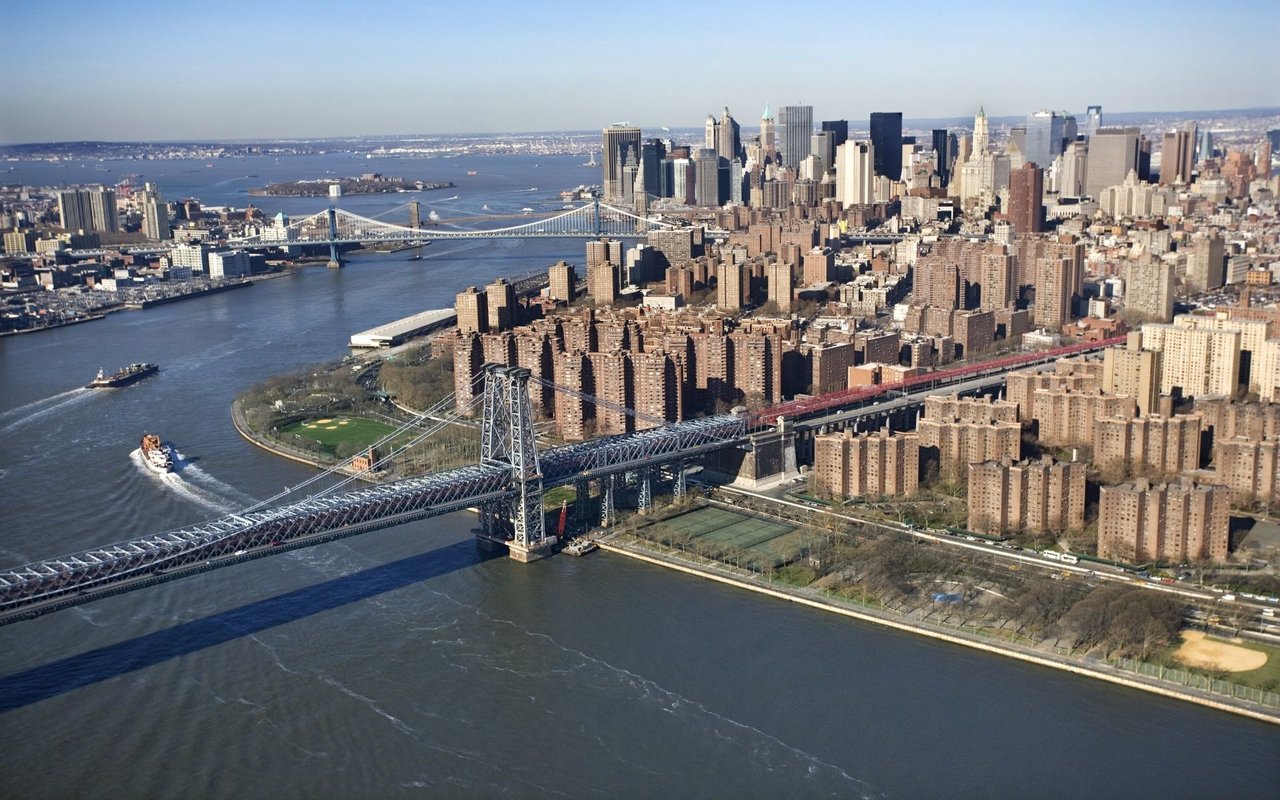
The waterfront along Kent Avenue has been the primary stage for Williamsburg's new development. The glass towers that now line the East River offer Manhattan skyline views, floor-to-ceiling windows, and the amenity packages that contemporary buyers expect. These buildings represent a category of residential product that did not exist in Brooklyn before Williamsburg demonstrated that the market would support it.
The most significant waterfront project is the Domino Sugar Factory redevelopment. The former refinery, which operated on the site from 1856 until 2004, is being transformed into a mixed-use complex that includes residential towers, commercial space, and Domino Park, a public waterfront park that has already become one of the most popular green spaces in the neighborhood. The project's scale and ambition reflect the degree to which Williamsburg's waterfront has been reimagined from an industrial edge into a residential destination.
Domino Park sits where sugar was once refined. The transformation is literal, and it is the story of Williamsburg in miniature.
Bedford Avenue: The Commercial Spine
Bedford Avenue runs through the heart of North Williamsburg and functions as its main street. The corridor between North Seventh Street and Metropolitan Avenue concentrates the neighborhood's dining and nightlife into a walkable commercial strip that operates with an energy level that is distinctly its own. The restaurants here skew younger and more experimental than the dining corridors in the brownstone neighborhoods to the south. The independent shops, while fewer in number than a decade ago, continue to give Bedford Avenue a character that chain-dominated streets cannot replicate.
The side streets off Bedford, particularly the blocks between Bedford and Berry Street, contain the neighborhood's most interesting mix of old and new residential stock. Former industrial buildings that have been converted into loft apartments sit next to newer mid-rise developments. The architectural variety within a few blocks is greater than in most Brooklyn neighborhoods, and the character of each building varies with its history and the quality of its conversion.
The Loft Conversions
Williamsburg's loft market is the direct descendant of the artist-led conversions that defined the neighborhood's earliest residential phase. The former industrial buildings, many of them constructed in the late nineteenth and early twentieth centuries for manufacturing and warehouse use, offered the kind of raw space that could not be found in Manhattan at comparable prices. The ceilings were high, the floor plates were open, and the windows were sized for industrial light rather than domestic proportions.
The best loft conversions in Williamsburg preserve those industrial qualities while updating the mechanical systems and finishes to contemporary standards. The less successful ones treat the industrial shell as a novelty and fill it with finishes that could belong to any new building. The distinction matters for resale value and for daily life. We counsel our clients on the structural quality of individual conversions because those details determine whether a loft will age well or become a renovation project within a few years.
McCarren Park and Neighborhood Life
McCarren Park, which straddles the border between Williamsburg and Greenpoint, is the neighborhood's primary green space. The park's running track, playing fields, and restored public pool provide outdoor amenities that the waterfront parks supplement but do not replace. On weekend mornings, the park's perimeter path and open lawns fill with residents in a way that gives the surrounding blocks a sense of community that the commercial corridors alone cannot create.
The L train, which runs beneath Fourteenth Street in Manhattan and crosses into Brooklyn at the Bedford Avenue station, is Williamsburg's primary transit connection. The single-line dependency is both a fact of life and a source of anxiety. When the L train was threatened with an extended shutdown for tunnel repairs, property values in the neighborhood dipped noticeably before recovering when the plan was revised to avoid a full closure. That episode illustrated how directly the neighborhood's residential market is linked to its transit infrastructure.
Our Perspective
Williamsburg is a market that rewards buyers who can distinguish between the neighborhood's reputation and its reality. The waterfront towers offer a contemporary residential experience with Manhattan views, but they are not the only option. The loft conversions on the interior blocks offer character that new construction cannot replicate. The distinction between North and South Williamsburg is fundamental. We guide our clients through these distinctions because the right purchase in Williamsburg depends on understanding which version of the neighborhood matches how they intend to live, and that understanding requires more than a weekend of open houses.